Access Is Not Intimacy
On horniness, loneliness, and the rebellion of owning our bodies


So what is that?
It is still entitlement. But now it is entitlement wearing queerness as camouflage.
In gay male culture especially, horniness is often normalised as currency. Desire is treated as casual, constant, frictionless. Apps have trained us into immediacy. “You up?” has become a social language. “Horny” becomes a greeting. “Right now” becomes a command.
But when someone who does not know your inner life, who does not show up for your grief, your rent, your creative work, your exhaustion, announces their arousal as though it requires your participation, what they are really saying is: your body is available to me because we share an orientation.
That is not intimacy. That is access culture.
Queer men grow up starved of affirmation. Many of us learned that desire was the only place we were allowed to feel powerful. So sex becomes proof. Being wanted becomes validation. Attention becomes oxygen.
And when someone feels bored, lonely, under-stimulated in their own life, the quickest way to feel alive is to reach for another body.
But this is where I ask these questions: Why is your boredom my emergency? Why is your libido more urgent than my boundaries? Why does your momentary desire assume I am waiting and ready?
There is something particular in queer male dynamics. Many of us were denied tenderness growing up. So instead of learning emotional literacy, we perfected sexual literacy. We can state what we want physically with confidence. But ask for closeness, care, consistency? That feels dangerous.
So “I’m horny” becomes safer than “I’m lonely.”
“Come over” becomes easier than “I miss being held.”
Because loneliness requires emotional exposure. It asks us to admit that we want more than bodies. That we want to be chosen in daylight. That we want consistency. That we want tenderness without a timer.
Horniness is armour. It is confident. It is uncomplicated. It carries no risk beyond logistics. If someone says no to sex, the ego can recover. But if someone says no to your loneliness, no to your need for closeness, that lands somewhere deeper.
So we lead with desire because desire feels powerful.
We say “right now” because urgency disguises vulnerability. We frame it as appetite, not ache. We keep it physical because the physical is easier to negotiate than the emotional.
To say “I’m lonely” is to confess that the night feels too long. To say “I miss being held” is to admit that sex is not the only hunger.
Many queer men learned early that softness was unsafe. That needing too much would make us undesirable. That masculinity required composure, detachment, and control.
So we perfected being wanted. We learned the choreography of sex. We learned how to initiate, how to detach afterwards.
But we did not always learn how to ask for care.
And so desire becomes the language we speak fluently, even when it is not the language we actually mean.
The tragedy is not that men feel horny. The tragedy is that horniness becomes the only socially acceptable way to express need. That intimacy is filtered through immediacy. That tenderness is compressed into urgency.
And when that urgency is directed at me as an obligation, I feel the weight of it. Not because desire is wrong. But because it bypasses honesty.
If you are lonely, say that. If you want to be held, say that. If you crave connection, build it. But do not disguise your ache as a command. Do not turn your vulnerability into my responsibility. You do not contribute to my daily stability. You do not show up in the unsexy hours.
Yet you assume access because we are both men.
That is patriarchy recycled. That is male entitlement unexamined. That is the inheritance of “my desire matters most” carried into queer spaces.
But, as queer Africans, autonomy over our bodies carries another layer.
Our bodies have never been neutral.
They have been legislated. Policed. Corrected. Mocked. Desired in secret. Denied in public. We come from histories where bodies like ours were controlled by church, by state, by family, by colonial law. Where masculinity was rigid and survival often required performance. Where softness was dangerous.
So when someone assumes access to my body now, even casually, even playfully, it echoes. It echoes every system that told us our bodies were not entirely ours. That we should be grateful for attention. That we should not be difficult. That we should not refuse.
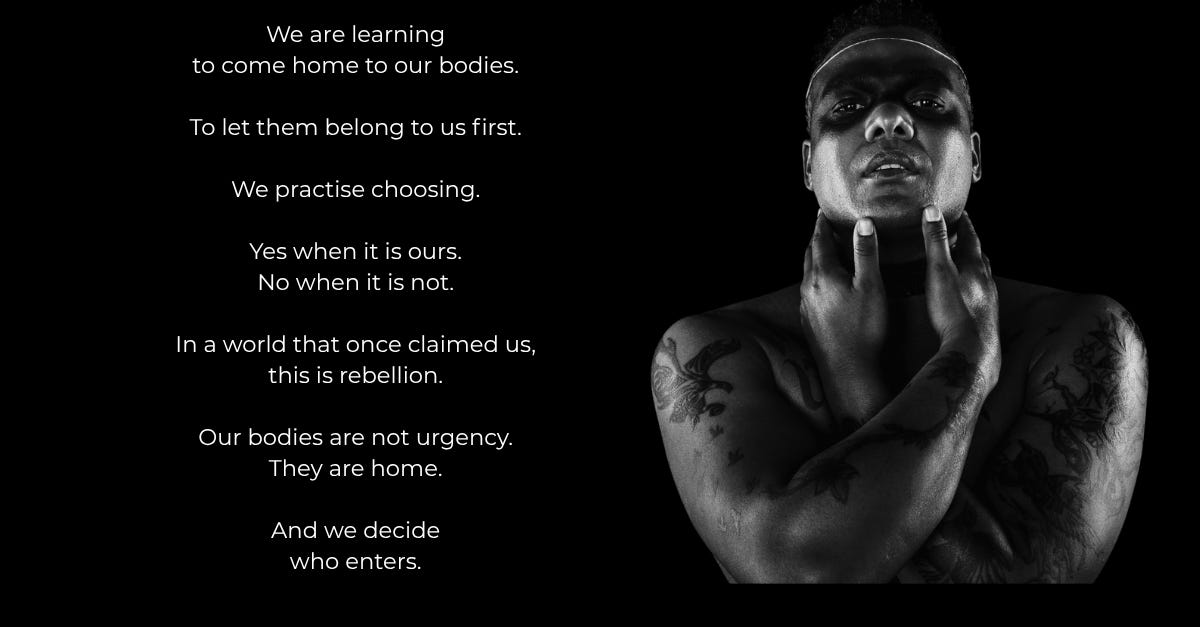
To say no, then, is not small. To say my body is not available simply because you want it is not dramatic. It is rebellion. It is the refusal to let urgency override sovereignty. It is the quiet insistence that consent is not implied by proximity, by shared queerness, by late-night loneliness.
Holding ownership over our bodies is an act of remembering. Remembering that we are not property. Not proof. Not convenience. Not currency.
We are allowed to desire. We are allowed pleasure. We are allowed hunger. But we are also allowed boundaries. Selectiveness. Stillness. Standards. And, sometimes, the most radical queer act is not performance. Not visibility. Not sexual availability.
It is saying:
Your arousal does not outrank my autonomy.
It is choosing to belong to ourselves first.